
Asia to North Europe rates slide into Golden Week
Spot rates from China to North Europe have now dropped for twelve weeks in a row. More services are sailing through the Suez Canal again, and Hamburg’s terminals are waiting for the result of a strike ballot. If you have orders leaving Chinese factories once the Golden Week holiday ends, the next three weeks will decide what you pay and how reliably your box arrives.
Spot rates are still falling
Drewry’s World Container Index of 1 October put Shanghai to Rotterdam at $3,399 per 40ft container, down 2% on the week. Shanghai to Genoa fell 3% to $3,702. The composite index slipped 1% to $4,434. A week earlier Rotterdam stood at $3,485, so the decline is steady and not a collapse.
Freightos saw the same direction in its update of 22 September: Asia to North Europe down 15% in a week to about $3,700 per FEU, and Asia to the Mediterranean down 7% to about $3,900, which it described as back to the level seen in May before the peak. The two indices measure slightly differently, so don’t expect them to match to the dollar. Both are port-to-port spot assessments. Your all-in price will also carry origin charges, terminal handling and on-carriage.
Drewry expects Asia to Europe rates to keep easing while Chinese factories are closed for the holiday. Carriers have announced higher FAK rates for the second half of October to stop the slide. We’ve seen plenty of these announcements fail when ships are not full, so treat them as an opening position and ask for a quote before you accept a higher number.
More ships are back on the Suez route
The bigger change is routing. Maersk and Hapag-Lloyd have moved four more Gemini Cooperation services from the Cape of Good Hope back to the Suez Canal: AE5, AE11, AE12 and ME2. According to WorldCargo News, AE11 switched on 19 September with its westbound sailing from Tanjung Pelepas, AE5 followed on 21 September and ME2 on 24 September. They join AE15 and AE19, which were already using the canal. AE5 serves Asia to North Europe, and ME2 links India with Europe, so shippers on our India lanes are affected too.
Both carriers said the change depends on the Red Sea staying stable. Drewry reports that Suez transits in week 39 were 68% higher than in the same week last year, and gCaptain put container ship transits at 48 in week 38, up from 41 the week before.
For you this means two things. Transit times on the switched services get shorter. And ships that no longer sail around Africa free up capacity, which adds to the pressure on rates. It also means schedules are being rewritten, so check the routing and ETA on every booking and don’t assume it matches your last shipment.
Blank sailings around the holiday
Carriers are pulling sailings to match the holiday dip, but so far in modest numbers on this trade. On 24 September Drewry counted seven blank sailings announced on Asia to Europe for the following week, up from three. Its 1 October update shows five for the coming week. A blanked sailing usually means your container rolls to the next departure, so a cheap rate on a cancelled ship is worth little. Ask which vessel and which week you are booked on.
Hamburg and the neighbouring ports
Kuehne+Nagel’s port update for 23 to 29 September shows a seven-day average vessel waiting time of 2.29 days in Hamburg, up from 2.13 days the week before. Yard occupancy was between 79% and 83%. Wind closed the Elbe at times and delayed arrivals, and there were isolated crane breakdowns, but schedules largely held.
Elsewhere, Bremerhaven’s yard was at 90% with about one day of waiting. Rotterdam averaged 1.68 days, with barge and feeder delays of 24 to 48 hours. Antwerp averaged 1.22 days.
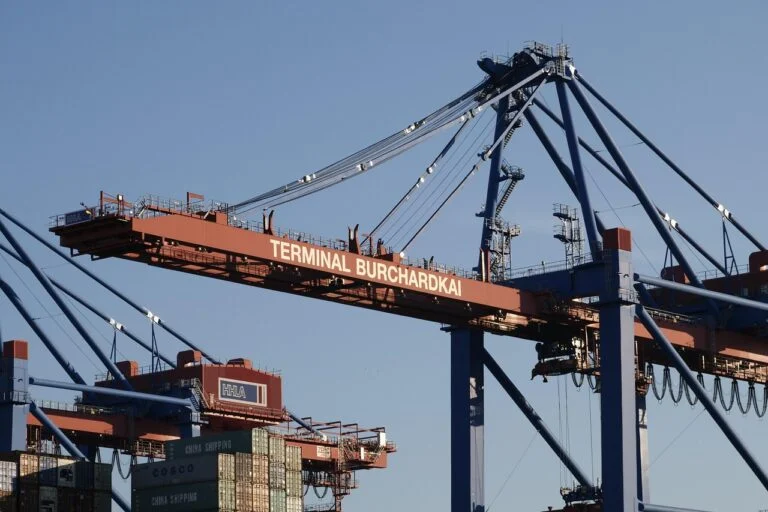
The open question is labour. After a 48-hour warning strike from the late shift on 2 September to 4 September at Hamburg, Bremerhaven and Wilhelmshaven, ver.di members rejected the employers’ offer of 3.4% by 64.7% in a survey of more than 5,500 employees. A formal ballot on indefinite strikes ran until the evening of 1 October. It needs 75% support, after which the union’s federal bargaining commission decides the next step. The dispute covers around 11,000 employees in six German seaports. When we wrote this on 3 October, we had not seen a published result.
What to do now
- If your cargo is ready after Golden Week, get a fresh spot quote. Don’t roll over a rate agreed in August.
- Ask your forwarder whether the service routes via Suez or the Cape, and plan your warehouse slots against the ETA you are given.
- Confirm the vessel and sailing week in writing, and ask what happens if the sailing is blanked.
- For Hamburg arrivals in October, allow a few extra days before fixed delivery dates until the strike question is settled. Have customs documents ready before arrival so the box can leave the terminal quickly.
- If a delivery date is critical, ask about routing via Bremerhaven, Rotterdam or Antwerp with road or rail on-carriage, and compare the full cost.
TradeRoute EU is a forwarder in Hamburg working with small and medium-sized importers and exporters. If you’d like current rates for your lane, ask us for a quote and we’ll reply within 24 business hours.
Sources
- Drewry: World Container Index, 1 October 2026 (accessed 3 October 2026)
- gCaptain: Container rates edge lower ahead of Golden Week as Suez traffic returns (accessed 3 October 2026)
- Freightos: Asia-Med rates back to pre-peak levels as Red Sea transits increase, 22 September 2026 update (accessed 3 October 2026)
- WorldCargo News: Maersk, Hapag-Lloyd step up Suez routings (accessed 3 October 2026)
- Kuehne+Nagel: Port operational updates from around the world (23 to 29 Sep 2026) (accessed 3 October 2026)
- Kuehne+Nagel: Port operational updates from around the world (16 to 22 Sep 2026) (accessed 3 October 2026)
- Bertling: Client notification, strike at German ports from 2 to 4 September 2026 (accessed 3 October 2026)
- ver.di Hamburg: Tarifrunde Seehäfen, Beschäftigte lehnen Angebot der Arbeitgeber mehrheitlich ab (accessed 3 October 2026)
- The Loadstar: German port workers move closer to indefinite strike after ver.di rejected pay offer (accessed 3 October 2026)